Travel Blog
Information
Esquiline Quarter & other sights of Rome
The Esquiline Quarter is located in the center of Rome, near Rome's main train station, Termini. A few important and beautiful churches are worth seeing in this district. This page also provides information on sights located a little outside of Rome's center, but easily accessible by metro, tram, and bus.
Content
Churches and Museums in the Esquiline Quarter
San Giovanni in Laterano
San Paolo Fuori le Mura
Appia Antica
Maxxi Museum
Villa Torlonia
(All of these sights, a few slightly outside of central Rome, can be easily reached by metro and bus)
1. Churches and museums in the Esquiline Quarter
Church of Santa Maria Maggiore - This remarkable 5th-century church is located in the center of the Esquilino district, near Roma Termini station. It has a beautiful choir façade. The monumental Marian Column, originally from the Roman Forum, stands in the square in front of the church. Inside, the well-preserved mosaics depicting 15 scenes from the story of Moses and Abraham are worth seeing. The majestic baldachin above the papal altar by Ferdinando Fuga was likely inspired by Gian Lorenzo Bernini's baldachin in St. Peter's. Basilica of Santa Prassede - This early medieval basilica is located near the Church of Santa Maria Maggiore. The first church on this site was built in the 3rd century and is the most important example of Byzantine art in Rome. Santa Prassede owes its fame primarily to its mosaics, which can still be seen unchanged today. The Zeno Chapel (Cappella di San Zenone), with its gilded mosaics, is considered one of the most important 9th-century buildings in Rome. Museo Nazionale d' Arte Orientale - This museum on Via Merulana, near the Church of Santa Maria Maggiore, presents works of art from the Orient, from the Middle East to Japan. Roma Termini, Rome's main train station, is located in the Esquilino district. Whether you need to take a train, go to the airport, take a day trip, or transfer from one subway line to another, you can't miss Rome's main train station, called "Stazione Roma Termini." The large, spacious station offers services for travelers and pedestrians on three levels, including attractive shopping opportunities, restaurants, and fast food options for every need. The basement also provides access to the metro, where metro lines A and B intersect.
2. San Giovanni in Laterano
Church of San Giovanni in Laterano - This church, the first Christian basilica in Rome, was built at the beginning of the 4th century. Fires destroyed the church twice, but it was rebuilt in its original form each time. The final interior remodeling was carried out by Borromini. The façade was not added until the 18th century. The Lateran Palace was the official papal residence, and until 1870, all popes were crowned in the basilica. Particularly noteworthy are the cloister (with twin columns and marble mosaics) and the octagonal baptistery. La Scala Santa di Roma. The 16th-century building called the Scala Santa was built by Domenico Fontana. The palace includes the Scala Santa, consisting of a series of 28 white marble steps, a chapel, and an oratory. According to tradition, the 28 steps of the Scala Santa, the Holy Stairs, are the very ones Jesus is said to have climbed during his trial in Pontius Pilate's palace in Jerusalem. They were brought to Rome by Saint Helena in the 4th century. The stairs are considered so sacred that believers only use them kneeling and praying in remembrance of Christ's suffering. The most famous and most visited Holy Stairs, a place of pilgrimage for Catholics, are located in the immediate vicinity of the Basilica of San Giovanni in Laterano. Piazza Vittorio Emanuele II - Near the "Museo Nazionale d'Arte Orientale" lies the "Piazza Vittorio Emanuele II." It is the largest square in Rome and is named after King Victor Emmanuel II. It is home to the Nymph of Alexander, an ancient, monumental Roman fountain.
3. San Paolo Fuori le Mura
Basilica of San Paolo Fuori le Mura - Taking the Metro B towards the sea will take you to this imposing church in just a few minutes. It boasts a beautiful façade and a faithful reconstruction of the 4th-century basilica, which burned down in 1823. Inside, you can see several beautiful mosaics. Link: https://basilicasanpaolo.org/en/ - Information about the Basilica di San Paolo fuori le Mura, in English. Musei Capitolini - Centrale Montemartini - This remarkable museum is also easily accessible by Metro B. A large old industrial complex (originally home to Rome's first power plant) has been converted into an art museum. Two of the giant generators in the central machine hall create a fascinating contrast to the works of art, consisting primarily of ancient statues. Link: http://www.centralemontemartini.org/en - Information about the Museo Centrale Montemartini, in English. What Harrods is to London, Eataly is to Rome. The only difference is that the department store in the Italian capital focuses less on luxury goods. Here, almost everything revolves around food. Anyone interested in discovering Roman and Italian cuisine can take a look at Eataly. Here, you can quickly see what Italian cuisine is all about and find high-quality food from all over Italy. Address: Piazzale 12 Ottobre, Rome - Eataly is located south of the center of Rome, just a few meters from the Piramide metro station.
4. Appia Antica
The Via Appia Antica began in Roman times at the Roman Forum and led far into the south of Italy, to Brindisi. Many of Rome's noble families had their tombs built along the Via Appia. Even today, these monuments, along with their memorial stones and tombs, shape the character of the Via Appia Antica. Link: https://www.parcoarcheologicoappiaantica.it/ - Information about the Parco archeologico dell'Appia Antica, in Italian only. Sights along the Via Appia include: The archaeological complex of the Villa of Maxentius stretches out in a scenic location on the Via Appia Antica. The villa consists of three main buildings: the palace, the circus, and the dynastic mausoleum, all built in honor of Emperor Maxentius. The most famous monument of the entire complex is the Circus, the only Roman circus whose architectural features are still well preserved. Also worth seeing is the imposing Mausoleum of Romulus. Link: http://www.villadimassenzio.it/en - Information on the Villa di Massenzio, Appia Antica, in English. The Catacombs of Domitilla on the Via Ardeatina / Via delle Sette Chiese are arguably the largest underground burial complex in Rome. They served as the final resting place for both pagan and Christian Romans. The Catacombs of San Callisto are an extensive complex with intricate passageways and numerous tombs. Link: https://www.catacombesancallisto.it/de/index.php - Information on the Christian catacombs of Rome, in German. The Church of San Sebastiano fuori le Mura, on the Via Appia, is one of Rome's seven pilgrimage churches due to the fame of the martyrdom of St. Sebastian. The circular structure of the Tomb of Cecilia Metella, visible from afar, is one of the most impressive monuments along the Via Appia Antica. It is the enormous, cylindrical tomb of the noblewoman Cecilia Metella. The Villa of the Quintilii, also called Roma Vecchia because the remains convey the appearance of an ancient city. A pyramid-like tomb core marks the entrance to the villa on the Via Appia. The impressive arched structures of the Aqua Appia aqueduct can be seen nearby. The Casale Rotondo, the largest monument on the Via Appia, has a cylindrical core, like the Mausoleum of Augustus. The Via Appia Antica is best reached by taking the Metro A (Colli Albani stop). From there, take bus number 660, which will take you to the center of the Via Appia Antica's attractions in just a few minutes. Another option for visiting the Via Appia Antica is the Roma Archeologica tourist bus, which departs from Stazione Termini station to the Via Appia. Near the Via Appia Antica, at the corner of Via Cecilia Metella, is the Caffe Appia Antica Caffèan, where you can enjoy a light meal outside in the garden and also rent bicycles.
5. Maxxi Museum
Maxxi - The National Museum of 21st-Century Arts (Museo nazionale delle arti del 21 secolo - "MAXXI") is located in northern Rome, near the "Foro Italico" and is easily accessible by tram from Piazza del Popolo. It is a contemporary art museum in Rome. The architect Zaha Hadid was commissioned to build it in 1998. The museum has an L-shaped layout and consists of several long, exposed concrete sections that appear to flow into, over, and under each other. Inside, the building is dominated by spacious galleries, slopes, ramps, and curves. Artificial and natural light from large glass facades illuminate the galleries, halls, and cabinets. The individual floors are connected by suspended black staircases. Link: https://www.maxxi.art/en/ - Information about the Maxxi Museum - Museo Nazionale delle Arti del 21 secolo, in English. Auditorium Parco della Musica - Located very close to the Maxxi Museum is the Auditorium, a cultural center opened in 2002. The building was designed by the Italian architect Renzo Piano. The Auditorium Parco della Musica includes concert halls, theater stages, and spaces for temporary exhibitions. The auditorium is home to the Accademia Nazionale di Santa Cecilia. Link: https://en.auditorium.com/ - Information about the Auditorium Parco della Musica, also available in English. Ponte della Musica - A modern bridge popular with skateboarders, allowing pedestrians and cyclists to reach the Foro Italico (a large sports complex). It is located near the Maxxi Museum.
6. Villa Torlonia
Villa Torlonia - North of the center of Rome, easily accessible by bus from the city center, this villa with a museum (mansion) is located in the middle of a beautiful park. Villa Torlonia was Mussolini's official residence from 1925 to 1943. Neoclassical sculptures can be found in the park. The Casino Nobile is an example of neoclassical architecture, and the remarkable "Casina delle Civette" is an Art Nouveau building that was recently converted into a museum. The villa and the park are open to visitors. Link: http://www.museivillatorlonia.it/en - Information about Villa Torlonia, in English. Coppedè Quarter - This district is easily accessible on foot from Villa Torlonia or the Villa Borghese park. The Coppedè Quarter is not actually a separate Roman district, but rather a neighborhood where squares, houses, and villas were built in the Art Nouveau style. The Quartiere is named after the architect Gino Coppedè, who realized this "work" on 31,000 square meters between 1915 and 1926. Between the streets Via Tagliamento, Via Arno, and Via Clitunno, buildings are lined up that, from an architectural perspective, are a potpourri of Art Nouveau, Baroque, and medieval styles. There are no souvenir shops, no cafés, or ice cream parlors here. No "ancient stones," no temples, or forums. Nothing else reminiscent of the Roman streets.

Church: Santa Maria Maggiore

Church : San Giovanni in Laterano

Church: San Paolo Fuori le Mura

Meeting point in the Appia Antica

Maxxi - Museum

Villa Torlonia
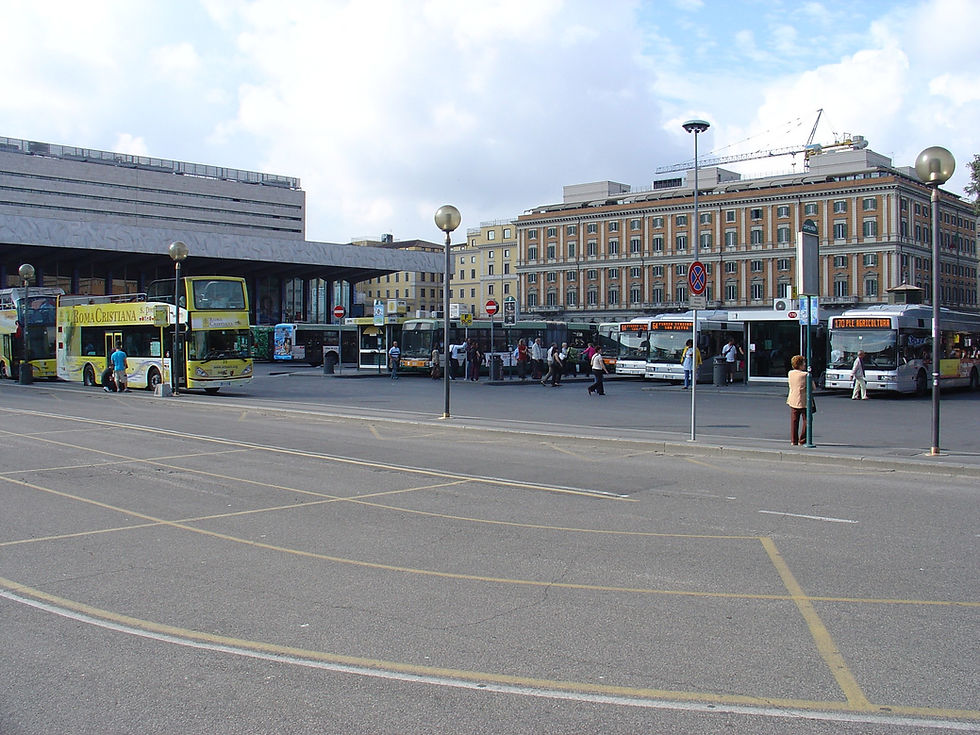
Rome's main train station: Roma Termini

Fori Imperiali - Mercati di Traiano

Appia Antica

Forum Boarium - Tempio di Fortunus

San Giovanni in Laterano: Building with Scala Santa

Villa Torlonia