Travel Blog
Information
< back
Capitol & Piazza Venezia
Here, on the Capitol, the smallest of Rome's seven hills, was the city's cult center, where all triumphal processions ended. The Capitol was home to the Temple of Jupiter Capitolinus, Rome's most important temple. Capitol Square, the Capitoline Museums, the Ara Coeli Church, and Piazza Venezia are all located close together and can be easily visited on foot.
Content
Capitoline Hill & Capitoline Square & Capitoline Museums
Santa Maria in Aracoeli & Caffarelli Terrace
Piazza Venezia & Palazzo Venezia & Palazzo Colonna
Vittorio Emanuele II Monument & Vittoriano Museum
Church of San Marco and Church of Il Gesu
Area Sacra dell'Argentina & Balbi Crypta Museum
(all these sights are easily accessible on foot from Piazza Venezia)
1. Capitol Hill & Capitol Square & Capitoline Museums
The Capitol was the center of the Roman world and remains the seat of the city government to this day. The Capitol is one of the Seven Hills of Rome and one of Rome's most visited sights. During the Renaissance, the hill was completely redesigned by Michelangelo, creating a wonderful ensemble that has survived to this day. Two staircases provide access to the Capitol: the very steep staircase, which leads directly to the Church of Santa Maria in Aracoeli, and the gently sloping ramped staircase, known as the Cordonata, designed by Michelangelo. Upon entering this staircase, you will notice an inconspicuous monument to the medieval Roman tribune Cola di Rienzo on the left. At the top of the staircase are the two statues of the Dioscuri Castor and Pollux. Cordonata - The ramped staircase (Cordonata), designed by Michelangelo, leads up to the Capitol Square. The beautiful staircase is decorated with lions, monuments, and statues. Once you reach the top of the stairs, you will see Capitoline Square in front of you (the equestrian statue of Marcus Aurelius stands in the center of the square), the Palazzo Nuovo to the left, the Palazzo dei Conservatori to the right, and directly in front of you the Palazzo Senatorio (where the mayor of Rome has his office). Capitol Museums - On Capitoline Square, to the left and right of the square are the Palazzo dei Conservatori and the New Palace. The Palazzo dei Conservatori was built by Giacomo della Porta based on designs by Michelangelo. The New Palace was designed by Michelangelo and built by Rainaldi in the 17th century. Today, both palaces are part of the Capitoline Museums (Musei Capitolini). Link: http://www.museicapitolini.org/en - Information about the Capitoline Museums, in English.
2. Santa Maria in Aracoeli & Terrace Caffarelli
Santa Maria in Aracoeli - To the left of the gently sloping Cordonata staircase leading up to Capitoline Square, there is a steep staircase (called the Aracoeli Staircase) that leads up to the Chiesa Santa Maria in Aracoeli. The church is located right next to the National Monument to Vittorio Emanuele II. Café of the Capitoline Museum (Café Capitolino) - You can linger outside on this observation terrace (called Terrazza Caffarelli) and enjoy the view over Rome's rooftops, or have a coffee or a snack on the comfortable sofas in the covered part of the terrace. This observation terrace is also open to non-museum visitors. Since the entrance to the palace and the terrace is not easy to find, we provide a brief description here. When you go up the stairs to the Campidoglio, turn right immediately at the top. Pass under a striking archway of Palazzo Caffarelli and immediately afterward, you'll find the door leading up to the terrace on the left. Link: https://www.terrazzacaffarelli.it/en/ - Information about Café Terrazza Caffarelli, in English.
3. Piazza Venezia & Palazzo Venezia & Palazzo Colonna
Palazzo Venezia - The Renaissance palace Palazzo Venezia, near Piazza Venezia, houses a museum. Here, you can admire first-class collections of early Renaissance paintings, painted wood sculptures, Renaissance commodes, and Italian paintings of the 17th and 18th centuries. The magnificent and absolutely must-see Baroque palace Palazzo Colonna is a noble palace on Piazza SS. Apostoli, located near Piazza Venezia. It has been owned by the Colonna family for 23 generations and is partially open to the public. The Galleria Colonna, located within the building, houses a significant art collection. You can also visit the beautiful gardens with a view of Rome (the palace and gardens are only open to guided tours, usually only on Saturdays). Link: https://www.galleriacolonna.it/de/ - Information about Palazzo Colonna, in German. Singer Palace Hotel's Observation Terrace An excellent destination for an aperitif on the sixth-floor terrace with 360-degree views of central Rome. Singer Palace is an elegant boutique hotel in the heart of ancient Rome, located approximately 300 meters from Piazza Venezia, in a small side street off Via del Corso. Address: Via Alessandro Specchi, Rome Phone: +39 06 697 61 61
4. Monument to Vittorio Emanuele II & Vittoriano Museum
Monument to Vittorio Emanuele II - If you climb the steps of the monument near Piazza Venezia, you will reach a terrace with a beautiful view over the rooftops of Rome. An elevator (for a fee) may take you even higher, to a viewing platform. Inside the monument is a museum (called the Museo del Risorgimento), which documents the unification of Italy. The Monument to Vittorio Emanuele II also houses the Vittoriano Museum Complex (Complesso del Museo Vittoriano). Some of the city's most important art exhibitions are held here every year, which is of particular interest to art lovers. This museum complex can be reached via the side street Via di San Pietro in Carcere. Link: https://vive.beniculturali.it/en/homepage - Information about the Vittoriano and Palazzo Venezia, in English.
5. Church of San Marco & Church Il Gesu
St. Mark's Church - The small church of Rome's Venetian community is located directly on Piazza Venezia. It was renovated in the 9th century and features beautiful apse mosaics. Il Gesu Church. This is the first Jesuit church in Rome, built in the 16th century. It is located not far from Piazza Venezia and is considered the prototype of Baroque churches, thus being mentioned in many textbooks on art and architecture. If you look up at the ceiling, you can admire the magnificent ceiling fresco "The Triumph of the Name of Jesus" by Giovanni Battista Gaulli (known as Baciccia). It almost seems as if you are actually gazing into the light of heaven. In the left transept is the Chapel of St. Ignatius. The chapel was designed by Andrea Pozzo, whose most brilliant work can be admired in Rome's second Jesuit church, Sant'Ignazio. To the left of the main altar is Bernini's marble bust of St. Roberto Bellarmino.
6. Area Sacra dell'Argentina & Museum Crypta Balbi
Doria Pamphilj Gallery. Giambattista Pamphilj, who became Pope under the name Innocent X, founded this beautiful gallery in the 17th century. Here you can admire works by Raphael, Titian, Domenichino, Parmigianino, Caravaggio, Carracci, Preti, Guercino, Reni, and Velasquez, among others. The gallery also houses ancient sculptures and other works from the 16th century, including sculptures by Bernini and Algardi. Link: https://www.doriapamphilj.it/en/ - Information about the Doria Pamphilj Gallery, in English. Area Sacra dell'Argentina - The so-called Area Sacra (Sacred Area), containing the relics of four temples that are among the oldest in Rome, lies below current street level and is easily visible from all sides. The first temple presumably dates back to the 3rd century BC based on the architectural forms of its oldest construction phase. Along with the third temple, it is considered one of the oldest sacred buildings on the Campus Martius. The site is not open to the public. The Crypta Balbi is part of the Museo Nazionale Romano and is located near Piazza Venezia and the Area Sacra dell'Argentina. Other museum locations include Palazzo Altemps near Piazza Navona and Palazzo Massimo alle Terme, near Roma Termini station. (Tickets are valid for all three museums.)

Capitol Square
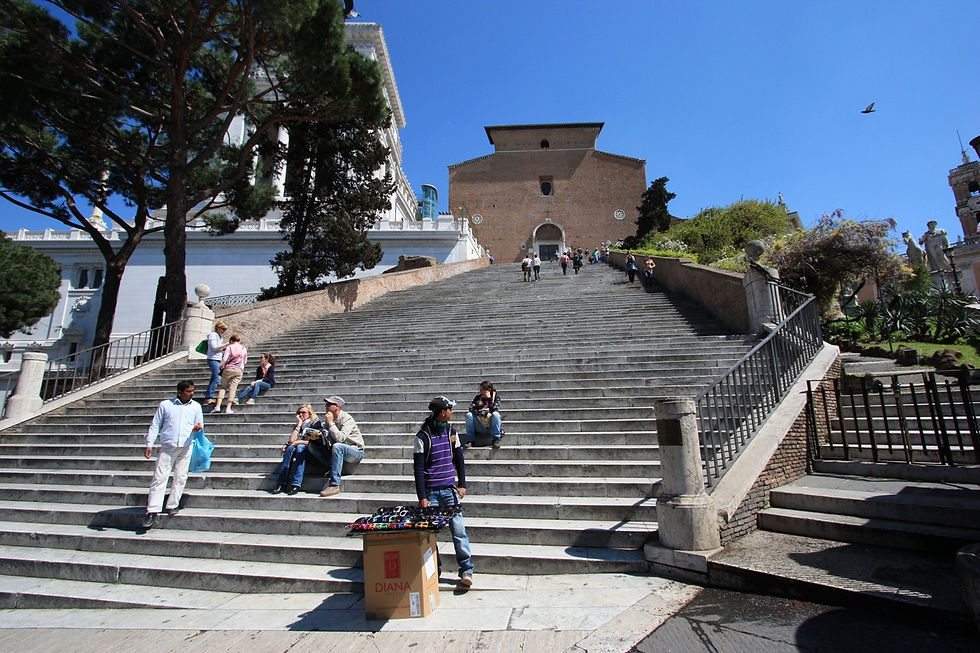
Steep stairs to the Aracoeli Church

Monument Vittorio Emanuele II

Monument to Vittorio Emanuele II

Church Il Gesu

Area Sacra dell'Argentina

Cordonata - Staircase

View from the gardens of Palazzo Colonna

View from the monument to Vittorio Emanuele II

Museo Centrale del Risorgimento, near Piazza Venezia

Terrazza Caffarelli, near Campidoglio

Area Sacra dell'Argentina